Tag Archives: joy

Cuba: Day Seven

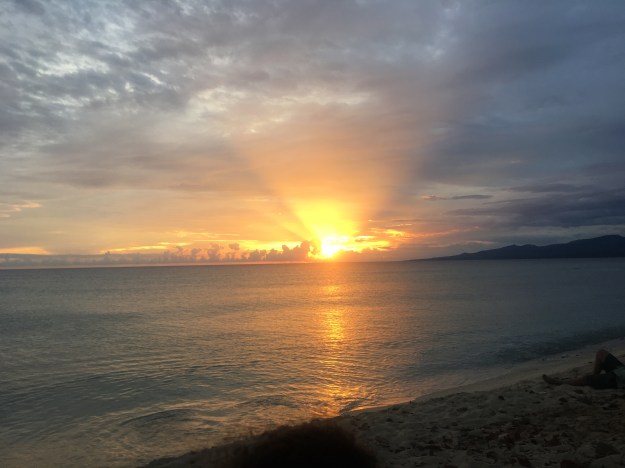
cuban beach sunset

Cuba may be poor and lack so many resources, but it is a beautiful island.

We spend an hour in the morning walking through the national park ” El Cubano” in the mountains of Escambay, just a thirty minute drive outside Trinidad.  The area is lush with a diversity of plants, birds and animals.  We had a guide who first attempted to narrate us through the biodiversity of the area, but we were rebelling that morning and were focused on reaching the end of the trail where a waterfall awaited.

Of course it was hot. Of course it was humid. It’s a tropical island.

The walk was up and down easy hills and we were all drenched in sweat when we reached our destination. The waterfall cascaded into a clear pool of cold water. Most of our group stripped to our swim suits and jumped in.

Our pace one tour was slowing down.  We only had another day together and by now, clusters of friends had formed: the under 40 New Yorkers; the two families bonded withe  50-something couple from New York; the 60-something couple from Oregon protecting the married mom traveling alone;the two single men from California each kept to themselves, but not awkwardly so.  The group worked well together during our nearly two weeks together.

We asked question of our guide and office other about Cuban politics and life; American politics; each others jobs… not surprisingly a high percentage of the group worked in non-profits or higher education.  We were balanced by our New Yorkers working in advertising, law and “investments.”

Dinner was at Playa Ancon.

Our bus stopped at what seemed to be someone’s house.  It was our caterer and our musicians for our evening on the beach.  The beach was almost vacant and what few people  were there left soon after our arrival because a storm was blowing our way. We thought for sure were we about to be hit with a tropical storm,  but, Dady, our lead guide said, “Let’s see…”

Everyone left the beach except us.

We were rewarded for our faith.

The few raindrops didn’t even dampen our clothes.

The sunset performed for us along with our musicians. Fresh fish, veggies and rum…an abundance of rum along with a few Cuban cigars.

Celebration in the joy of Cuba’s beauty.
 

Cuba: Day Six

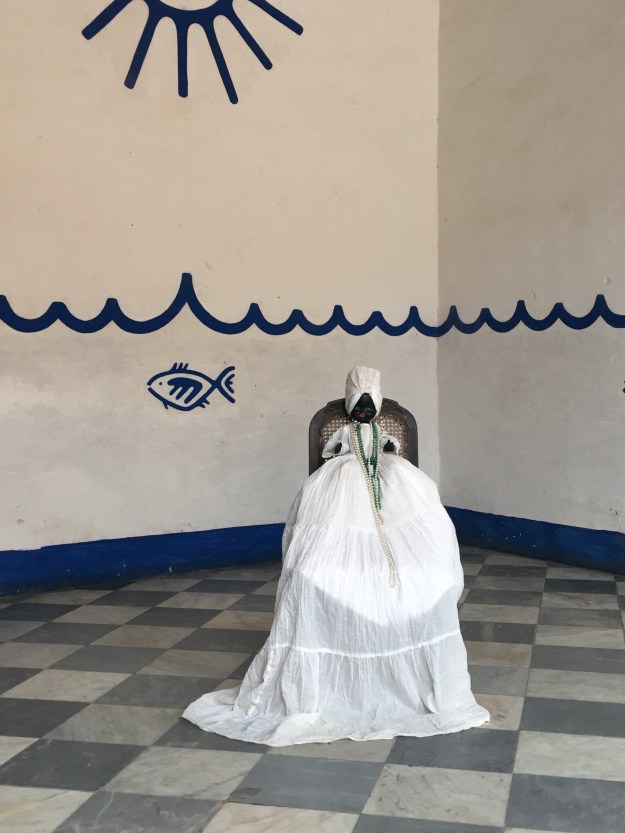
santeria temple

Trinidad, Cuba.

The first time I’d ever heard of Santeria and seen the Casa Templo de Santeria: Yemaya was on the Departures TV series when Canadian travelers, Scott Wilson and Justin  Lukach, walked into what appeared to be a regular storefront business on the cobbled streets of Trinidad.

What they found was  a black “doll” dressed in all white sitting on a chair in the middle of an empty room. She represents the sea goddess, Yemaya.

It’s startling not just because of what it is, but the room has an energy and calmness at the same time.  A very palatable feeling.

The high ceiling, white walls and blue fish and water paintings created a calm and cooler atmosphere contrasting heavily with the heat, humidity and ruggedly cobblestone streets of this UNESCO cited Spanish Colonial city located in the southern, center part of Cuba.

Our group had an appointment with the Temple Priest to learn about this religion that mixes traditions and beliefs brought by West African slaves and over years, mixed with Spanish Colonial Catholicism.

More than 70% of Cubans practice this religion.  Many come to the Priest for advice about work, love, decisions to be made… the advice is typically a mix of prayer and rituals centered around plants, fruits, vegetables and animals.

The Temple is closed on Sunday because the Priests attend mass in the Catholic Church.

This is when I wish I had started my Spanish lessons earlier so that I could return and converse with the Priest.  Through our translator I learned the Priests only wear white and the people I had seen in the streets in all white were either devotees of the religion or studying to become Priests.  Unfortunately, my infant-level Spanish prevented me from further engagement.

Dady, our lead guide had given us all street maps of Trinidad because “the streets all have two names and are confusing because they follow no pattern.”

Boy, was she right.

You learn early that the center of this small community is at the higher elevation and our casa was “down the slope.”  Streets and cobbled and challenging to walk. My husband and I were lost on our afternoon walk and about to head in the completely wrong direction when our son spotted us and put us on the right course.

Hot. Humid. A much poorer community than Cienfuegos the day before.

The peak tourist season had ended which I liked, but it made for empty streets and empty bars.

Our casa was “under construction” and more “rustic” than others. The family, however, was as warm and kind as we had learned to expect.  We had lunch there and were served our first treat of Cuban helado. My husband had both chocolate and vanilla.

He and our son met up with others in the group that evening to find a hotel to watch the NBA playoffs.

I stayed in the room to write and read my book on Che I’d found in the town earlier that day.


Cuba: Day Four


Cigars stink. But not in Cuba.

I don’t know much about cigars, but I’ve puffed one or two and have been around their foul odor.

Cuban cigars are different.

After spending a morning walking the tobacco fields, meeting the farmer, holding leaves that were curing in the thatched roofed storage house, then watching the farmer’s grown son roll each of us our own cigar…

… I can say these cigars smell and taste sweet and mild.

Most of our group sat in the small hut with Clara and her son puffing away and it was not offensive as cigar rooms elsewhere. No stale, foul odor.

Clara was puffing away on her own cigar when we arrived. I told her, “El nombre de mi abuela es Clara.”

She grinned, nodded and took me under her tutelage showing me how to hold the cigar and puff “just so.”

The family spends nine months harvesting their fields and receive the equivalent of 1,000 CUCs for their labor. “That’s the same cost as 1,000 beers,” says this morning’s guide.

We all stand still looking at our cigars and each other. Work for nine months for the price of 1,000 beers.

Most of us decided to buy as many cigars as allowable from Clara and her family.

The morning walk around the tobacco farm in the heat and humidity was tiring so we  adjourned to our private casas after lunch for siestas during the afternoon rain.

Dinner was on top of another hill with a vista view of the mountains and sunset.  Our tables and chairs sat on a  platform balcony leaning over the cliff.  The kitchen of this small, family-owned paladares was “out back” with the cats, chickens, turkeys, pigs and other farm animals.

The open fire grill was so hot that none  of us could stand within five feet of it.  Our chef just shrugged and prepared another delicious meal (of the same, in-season and only food available meal)

Our group was very compatible and our conversations covered politics, dating, parenting, travel…Dady, our lead guide was educated and well-informed and engaged in sharing her thoughts and perspectives about her country and the world.

Having these dinners talks while on a balcony suspended over the cliff, looking across the valley toward the sun setting behind the mountains made the evening paradise.

For the second night, I thought, “I really don’t want to leave this part of Cuba.”


Cuba: Day Three


New York is not The City. England is not London. France is not Paris. Cuba is not Habana.

Leave the city and discover natural beauty, a slower pace and people willing to sit and talk.

Less than an hour’s drive west of Havana you are in the middle of a jungle of rolling hills and distant mountains.

There are few cars in and Habana and almost none on the highways. Cars are expensive and gas is cost prohibitive for most. People stand in the shade under overpasses holding out money or bananas or mangoes in exchange for a lift. Now and then you see a horse drawn cart.

We spent most of the day in the Sierra del Rosario Biosphere Reserve, a UNESCO site of 12,355 acres of preserved natural beauty. Designated in 1984, it is one of six UNESCO sites on the island.

Beginning in the 1800s, coffee plantations stripped much of Cuba of its natural beauty. By 1959, only 19% of Cuba was forested. After the revolucion, the government decided to reforest the land. More than 3000 people were engaged in planting 8 million trees.

The village of Las Terrazas was established by Castro’s government as a model of socialist community and sits in the middle of this reforested paradise. Omar, our guide for this part of our day, was born and has lived in this village is entire life. As a result he can see and hear birds, animals and insects that none of us could without his careful prompting.

The village was planned by an architect and as a result the buildings have uniform white stucco walls with red tile roofs. Paths wander from building to building, the village school, houses, apartments, playgrounds, the zip line course primarily for tourists and down to the lake.

Cuban artist, Lester Campo, has his studio on the shores of the Lake. Omar was so proud to discuss this internationally successful artist and how, “though he has traveled all over the world, he always comes home to Las Terrazas.”

The artist was out of the country, but his girlfriend was in the studio and happy to sell us lithographs of his work. His originals were too expensive for our group.

The community was very quiet and a few people were seen.

My husband asked Omar if there were other such communities throughout Cuba.

“No. It’s too expensive.”

Too bad.

Lunch was the same as all meals: tomato, cucumber, cabbage, beans, rice, and your choice of pollo, cane or pork. It was a lovely lunch, however, because we ate in the shade outside beside a creek with small waterfall slides. Most of us went swimming after our meal.

We drove to Vinales late in the afternoon. Vinales is one of the most picturesque parts of Cuba. It is among the limestone pin cushion hills called mogotes. It is small community  filled with casa particulares, the equivalent of B & B’s.

I am so glad we were not there during tourist season because it is obvious this is an area that exists to serve tourists who want to see this exquisitely beautiful countryside.

We arrived at our casa just in time to sit on the veranda, sheltered from the hour-long torrential rain that marked the prelude to the hurricane season. Our hostess had fresh juice for us and we grabbed our light jackets to stay warm as temperatures quickly dropped, a welcome relief from the heat and humidity.

Dinner was the most magical dining experience I have ever had.

It was at the organic farm owned by Wilfredo Garcia Correa and his family. The farm house sat high on a hill over looking the Vinales Valley with craggy mountains seen off in the distance. Dinner was on the porch over looking the fields and valley with the sun setting off in the distance. It didn’t matter that it was the same food as all other meals.

Chickens, as always were everywhere and now we had the addition of farm kittens walking around our feet.

Not wanting the evening to end, our group declined our bus ride and, with Dady, our lead guide, we walked the two miles back to the center of the community and to our casas.

I want to stay here.