Tag Archives: humanity

Cuba: Day Six

santeria temple

Trinidad, Cuba.

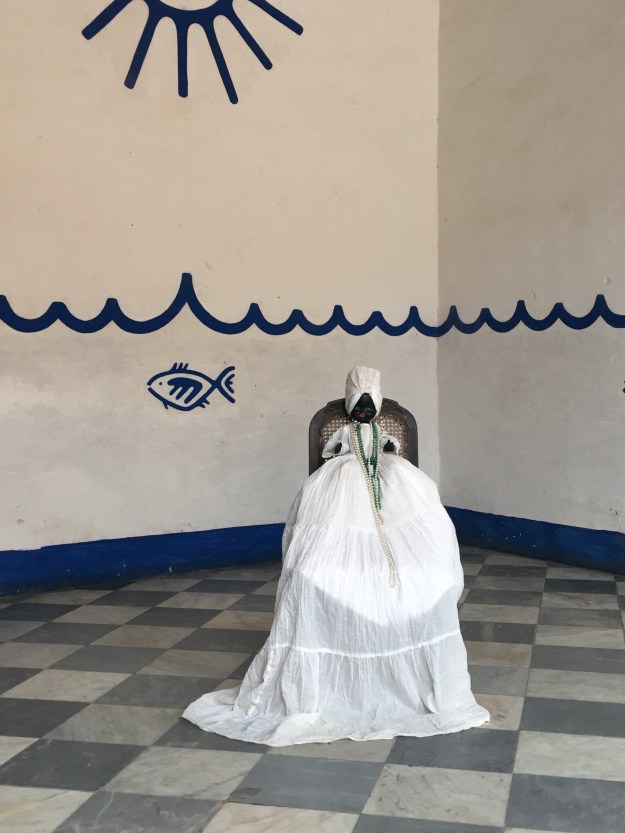
The first time I’d ever heard of Santeria and seen the Casa Templo de Santeria: Yemaya was on the Departures TV series when Canadian travelers, Scott Wilson and Justin  Lukach, walked into what appeared to be a regular storefront business on the cobbled streets of Trinidad.

What they found was  a black “doll” dressed in all white sitting on a chair in the middle of an empty room. She represents the sea goddess, Yemaya.

It’s startling not just because of what it is, but the room has an energy and calmness at the same time.  A very palatable feeling.

The high ceiling, white walls and blue fish and water paintings created a calm and cooler atmosphere contrasting heavily with the heat, humidity and ruggedly cobblestone streets of this UNESCO cited Spanish Colonial city located in the southern, center part of Cuba.

Our group had an appointment with the Temple Priest to learn about this religion that mixes traditions and beliefs brought by West African slaves and over years, mixed with Spanish Colonial Catholicism.

More than 70% of Cubans practice this religion.  Many come to the Priest for advice about work, love, decisions to be made… the advice is typically a mix of prayer and rituals centered around plants, fruits, vegetables and animals.

The Temple is closed on Sunday because the Priests attend mass in the Catholic Church.

This is when I wish I had started my Spanish lessons earlier so that I could return and converse with the Priest.  Through our translator I learned the Priests only wear white and the people I had seen in the streets in all white were either devotees of the religion or studying to become Priests.  Unfortunately, my infant-level Spanish prevented me from further engagement.

Dady, our lead guide had given us all street maps of Trinidad because “the streets all have two names and are confusing because they follow no pattern.”

Boy, was she right.

You learn early that the center of this small community is at the higher elevation and our casa was “down the slope.”  Streets and cobbled and challenging to walk. My husband and I were lost on our afternoon walk and about to head in the completely wrong direction when our son spotted us and put us on the right course.

Hot. Humid. A much poorer community than Cienfuegos the day before.

The peak tourist season had ended which I liked, but it made for empty streets and empty bars.

Our casa was “under construction” and more “rustic” than others. The family, however, was as warm and kind as we had learned to expect.  We had lunch there and were served our first treat of Cuban helado. My husband had both chocolate and vanilla.

He and our son met up with others in the group that evening to find a hotel to watch the NBA playoffs.

I stayed in the room to write and read my book on Che I’d found in the town earlier that day.


Cuba: Day Five (What about Camilo?)

Fidel

Che

Raoul

Camilo

…wait, Who?

Camilo Cienfuegos.

Oh, the image etched in steel alongside a massive building at the Plaza de la Revolution. We thought it looked like Juan Valdez, the coffee guy.

Camilo. Son of a tailor, born in Habana.

Too poor to continue college so he goes to America to find work. His visa expires and he’s sent back to Cuba.

His life changes when Batista’s troops shoot him and others who were honoring the memory of a socialist hero.

He was with Fidel when the Granma landed in Cuba, 2 decembro, 1956 to start the revolution.

A commandant like Che.

The “Hero of Yaquajay.”

He and Che lead the rebels in the final battle against Batista’s reign. Not a shot was fired as the two Comandante’s forces united and surrounded the troops of the President that the not even the US wanted when he fled Cuba the next day.

Commandante Camilo served as head of Armed Forces the first year of Castro’s Government.

Then, one night, his plane mysteriously disappeared, never to be found. He was 27 years old.

Camilo was once asked by Fidel during a speech, “How I’m doing?”

Camilo answered, “Vas bien, Fidel.”

The crowd took up the chant, “Vas bien, Fidel” and the quote is inscribed on the steel outline of his image in the Plaza. “Vas bien, Fidel” An image that was only placed there fifty years after his death. Che’s image had been immortalized there almost immediately after his death.

Even Cubans believe there was mystery behind Camilo’s death. The commandante did not support violence and death against enemies of the state. He was a socialist, perhaps a communist, but was quoted saying he would not treat prisoners the way Batista treated his enemies.

More egregious, however, was he was divorcing his wife to marry a wealthy woman and had always had a “joie de vive” that did not match the seriousness of a revolucion.

Some believe Fidel consolidated his power by sending Che to other countries to promote revolucion and eliminating Camilo undercover of the night.Who really knows? Raoul?

Che died a martyr, every revolution needs one.

Camilo has slowly been recognized on currency, schools, cities, museums…

What will they do when Fidel’s time has come?


Cuba: Day Five

The bus trip from Vinales, southwest of Habana, to Cienfuegos, near the center of the island on the southern shore, was going to take at least six hours of drive time.  Fortunately, we had several stops and the day was of conversation about Cuban history (since Castro’s Revolution) and culture.

The highway was desolate.  Miles pass without seeing any other motorized vehicle.

In the morning we watched a documentary on the bus about Fidel that was made by Americans. It featured many American notables such as former US Attorney General, Ramsey Clark, giving what seemed to be a balanced view of what the Revolucion was about.  In a way, Fidel’s Revolucion felt like an early version of the “anti 1%” activity that occurred briefly in the States in 2014/15 and then was squelched. (Yes, Cubans call their President Fidel, not President Castro)

No question that former Cuban President Batista was a bad boy. It was said during his reign that the U.S. ambassador to Cuba had more power than Batista. Worse, however, was the mafia control of gambling, wealth and industry and the blatant disregard for the average Cuban.

My take away from the documentary was that the United States and Cuban governments allowed dogma and the threat of communism to blind them from clear decision-making in establishing diplomatic relations. Fidel spent much of his time in the United States after the revolution trying to raise money for his island country that, for the first time in its history, was actually being governed by Cubans instead of monarchs from other, primarily European, countries.

After stopping for lunch in a unusual property which seemed to also be a massive petting zoo with buffalo, peacocks and other assorted animals scattered throughout the property, we arrived at the Korimakao Cultural Center.

The Korimakao Cultural Center  in Cinega de Zapata was established by Fidel as a Center where artists could develop their talents. These are young students who are not good enough for the university or for immediate employment in the cabarets or dance and performing troops, so the center is where they can hone their skills.

It is a modest campus of one-story white stucco buildings. There was no air conditioning in any of the buildings we visited and the dormitory restrooms were quite rustic and odorous.

The studios were rooms with open windows and plywood floors that were elevated on two by six beams to provide some measure of flexibility when jumping, especially for the dancers. The first performance presented to our small group was of two male dancers in a lovers quarrel complete with angst, anger and ultimate forgiveness and love.

The two young male dancers were quite earnest in their originally choreographed performance. Though homosexuality has been legal in Cuba since the 1970s, there is still much discrimination and bias against the LBGT Community. It seemed these Male dancers in their early 20s were trying to show how progressive their country was with their slightly homo-erotic performance.

We then watched a couple more performances from the full dance troupe and then listened to an acappella choir.

While there was definitely talent among these young students, it very much felt like a typical high school performance one would see in the United States. Their professional fate was probably no different than the thousands of young artists who pursue Broadway or Hollywood or other artistic venues. Some will make it, most will not.

More driving until we reached Playa Giron, better known as the Bay of Pigs. We stopped along the highway at a location designed just for people like us to swim in the sea or jump into a cenote.

The cenote was located deeper into the jungle down a winding path past the restrooms where we could change into our swimsuits. The cenote looked like a fetid,  mosquito-infested black pool. We all opted for the sea instead.

There was no beach. Instead there was an abrupt drop into deep waters.

“No wonder we lost in the bay of pigs invasion,” said my husband looking at the deepwater.

“Yes, many Cubans have wondered why the Americans selected the southern part of the island to attempt an invasion by sea here. It’s just too deep and there is no easy way onto the land,” said our guide. “Our northern shores are beautiful sandy beaches that can easily be approached by sea.”

Hmmm…

The road between Playa Giron and Cienfuegos contained more billboards with Revolutionary images and slogans than we had seen in any other part of Cuba. Even former Venezuelan dictator, Hugo Chavez, has a notable presence exclaiming the virtues of revolution.(Hmmm, again, given the ruined economic state of Venezuela today)

Cienfuegos is known as the “Pearl of the south.”

It is the largest city we have been near since we left Habana. I immediately noticed how many people seemed to be in their teens and 20s. This is a much younger and more cosmopolitan community than anywhere we have been so far on the island.

Our Casa Particulare was the most luxurious so far. The property was pristine in it’s mosaic tile floors and decor. The second floor balcony was designed for guests to lounge and enjoy the sunset. Our rooms were decorated in bright colored silk sheets and curtains.  Our towels were shaped into swans sitting on top of our beds.

With umbrella in hand, I asked our proprietress, “Lluvia?”. She shook her head no and so I took the umbrella back to my room before boarding the bus to go across town for dinner.

A monsoon struck the town just as we walked into the restaurant. The rain was so heavy that the drainage system began to back up flooding the restaurant. We continued to eat out od respect for the owners and staff who were working so hard to mop and sweep the rising tide out the kitchen door. We simply propped our feet upon the rails of our chairs to not get wet.

It made for fun conversation and great camaraderie with the restaurant staff.
 

Cuba: Day Four


Cigars stink. But not in Cuba.

I don’t know much about cigars, but I’ve puffed one or two and have been around their foul odor.

Cuban cigars are different.

After spending a morning walking the tobacco fields, meeting the farmer, holding leaves that were curing in the thatched roofed storage house, then watching the farmer’s grown son roll each of us our own cigar…

… I can say these cigars smell and taste sweet and mild.

Most of our group sat in the small hut with Clara and her son puffing away and it was not offensive as cigar rooms elsewhere. No stale, foul odor.

Clara was puffing away on her own cigar when we arrived. I told her, “El nombre de mi abuela es Clara.”

She grinned, nodded and took me under her tutelage showing me how to hold the cigar and puff “just so.”

The family spends nine months harvesting their fields and receive the equivalent of 1,000 CUCs for their labor. “That’s the same cost as 1,000 beers,” says this morning’s guide.

We all stand still looking at our cigars and each other. Work for nine months for the price of 1,000 beers.

Most of us decided to buy as many cigars as allowable from Clara and her family.

The morning walk around the tobacco farm in the heat and humidity was tiring so we  adjourned to our private casas after lunch for siestas during the afternoon rain.

Dinner was on top of another hill with a vista view of the mountains and sunset.  Our tables and chairs sat on a  platform balcony leaning over the cliff.  The kitchen of this small, family-owned paladares was “out back” with the cats, chickens, turkeys, pigs and other farm animals.

The open fire grill was so hot that none  of us could stand within five feet of it.  Our chef just shrugged and prepared another delicious meal (of the same, in-season and only food available meal)

Our group was very compatible and our conversations covered politics, dating, parenting, travel…Dady, our lead guide was educated and well-informed and engaged in sharing her thoughts and perspectives about her country and the world.

Having these dinners talks while on a balcony suspended over the cliff, looking across the valley toward the sun setting behind the mountains made the evening paradise.

For the second night, I thought, “I really don’t want to leave this part of Cuba.”


Cuba: Day Three


New York is not The City. England is not London. France is not Paris. Cuba is not Habana.

Leave the city and discover natural beauty, a slower pace and people willing to sit and talk.

Less than an hour’s drive west of Havana you are in the middle of a jungle of rolling hills and distant mountains.

There are few cars in and Habana and almost none on the highways. Cars are expensive and gas is cost prohibitive for most. People stand in the shade under overpasses holding out money or bananas or mangoes in exchange for a lift. Now and then you see a horse drawn cart.

We spent most of the day in the Sierra del Rosario Biosphere Reserve, a UNESCO site of 12,355 acres of preserved natural beauty. Designated in 1984, it is one of six UNESCO sites on the island.

Beginning in the 1800s, coffee plantations stripped much of Cuba of its natural beauty. By 1959, only 19% of Cuba was forested. After the revolucion, the government decided to reforest the land. More than 3000 people were engaged in planting 8 million trees.

The village of Las Terrazas was established by Castro’s government as a model of socialist community and sits in the middle of this reforested paradise. Omar, our guide for this part of our day, was born and has lived in this village is entire life. As a result he can see and hear birds, animals and insects that none of us could without his careful prompting.

The village was planned by an architect and as a result the buildings have uniform white stucco walls with red tile roofs. Paths wander from building to building, the village school, houses, apartments, playgrounds, the zip line course primarily for tourists and down to the lake.

Cuban artist, Lester Campo, has his studio on the shores of the Lake. Omar was so proud to discuss this internationally successful artist and how, “though he has traveled all over the world, he always comes home to Las Terrazas.”

The artist was out of the country, but his girlfriend was in the studio and happy to sell us lithographs of his work. His originals were too expensive for our group.

The community was very quiet and a few people were seen.

My husband asked Omar if there were other such communities throughout Cuba.

“No. It’s too expensive.”

Too bad.

Lunch was the same as all meals: tomato, cucumber, cabbage, beans, rice, and your choice of pollo, cane or pork. It was a lovely lunch, however, because we ate in the shade outside beside a creek with small waterfall slides. Most of us went swimming after our meal.

We drove to Vinales late in the afternoon. Vinales is one of the most picturesque parts of Cuba. It is among the limestone pin cushion hills called mogotes. It is small community  filled with casa particulares, the equivalent of B & B’s.

I am so glad we were not there during tourist season because it is obvious this is an area that exists to serve tourists who want to see this exquisitely beautiful countryside.

We arrived at our casa just in time to sit on the veranda, sheltered from the hour-long torrential rain that marked the prelude to the hurricane season. Our hostess had fresh juice for us and we grabbed our light jackets to stay warm as temperatures quickly dropped, a welcome relief from the heat and humidity.

Dinner was the most magical dining experience I have ever had.

It was at the organic farm owned by Wilfredo Garcia Correa and his family. The farm house sat high on a hill over looking the Vinales Valley with craggy mountains seen off in the distance. Dinner was on the porch over looking the fields and valley with the sun setting off in the distance. It didn’t matter that it was the same food as all other meals.

Chickens, as always were everywhere and now we had the addition of farm kittens walking around our feet.

Not wanting the evening to end, our group declined our bus ride and, with Dady, our lead guide, we walked the two miles back to the center of the community and to our casas.

I want to stay here.