Tag Archives: travel journal

Cuba: Days Eight & Nine

we 3 in front of che

“Ever Onward to Victory”

Our final two days were back in Habana.

Impressions:

Yes, Cuba is poor in materials and even natural resources.

Tourism seems to be its most stable and successful business.

Outside Habana, the country is a beautiful island with hills, mountains, rivers, waterfalls, biospheres, chickens roaming everywhere and roosters waking you at 4:45 AM.

People outside walking, walking, walking, hitching a ride when they can, rarely a private car in sight.

Food extremely limited in variety but served with pride in generous portions.

Music.

Dance.

Heat. Humidity.

Kindness. Smiles.

Feeling, not like a tourist. No begging. No hassles.

Cubans love their country and see its flaws. They want a better standard of living but don’t want to be “too commercial like America.”

Cubans we met love Americans and think our two governments are “silly and we need to be friends.”

Cubans love Fidel and know he’s “holding on too much to the revolution.”

Cubans love Raoul and “believe will take us forward.”

They are proud of their schools and medicine.

Stay in a Casa Particulares with Cuban families. The hospitality is enriching to the soul.

Eat in a palador, not restaurants for the same reason.

Swim in the sea.

Hike in the hills.

Walk the tobacco farms.

Learn the revolucion, Bay of Pigs, and the embargo from their perspective.

Buy books written from their perspective.

Leave behind as much as you can: lotions, sunscreens, toilet paper, mosquito repellant, clothes, tips… the staff at the casas appreciate it greatly.

Listen as much as you can.

Ask questions.

Learn as much Spanish as you can and speak it.

Leave behind your kindness and compassion.

Take with you a better understanding that people are people.

We really want the same things.


Cuba: Day Seven

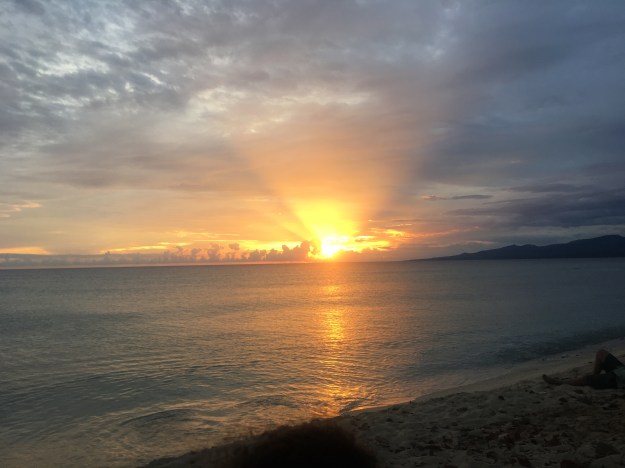
cuban beach sunset

Cuba may be poor and lack so many resources, but it is a beautiful island.

We spend an hour in the morning walking through the national park ” El Cubano” in the mountains of Escambay, just a thirty minute drive outside Trinidad.  The area is lush with a diversity of plants, birds and animals.  We had a guide who first attempted to narrate us through the biodiversity of the area, but we were rebelling that morning and were focused on reaching the end of the trail where a waterfall awaited.

Of course it was hot. Of course it was humid. It’s a tropical island.

The walk was up and down easy hills and we were all drenched in sweat when we reached our destination. The waterfall cascaded into a clear pool of cold water. Most of our group stripped to our swim suits and jumped in.

Our pace one tour was slowing down.  We only had another day together and by now, clusters of friends had formed: the under 40 New Yorkers; the two families bonded withe  50-something couple from New York; the 60-something couple from Oregon protecting the married mom traveling alone;the two single men from California each kept to themselves, but not awkwardly so.  The group worked well together during our nearly two weeks together.

We asked question of our guide and office other about Cuban politics and life; American politics; each others jobs… not surprisingly a high percentage of the group worked in non-profits or higher education.  We were balanced by our New Yorkers working in advertising, law and “investments.”

Dinner was at Playa Ancon.

Our bus stopped at what seemed to be someone’s house.  It was our caterer and our musicians for our evening on the beach.  The beach was almost vacant and what few people  were there left soon after our arrival because a storm was blowing our way. We thought for sure were we about to be hit with a tropical storm,  but, Dady, our lead guide said, “Let’s see…”

Everyone left the beach except us.

We were rewarded for our faith.

The few raindrops didn’t even dampen our clothes.

The sunset performed for us along with our musicians. Fresh fish, veggies and rum…an abundance of rum along with a few Cuban cigars.

Celebration in the joy of Cuba’s beauty.


Cuba: Day Six

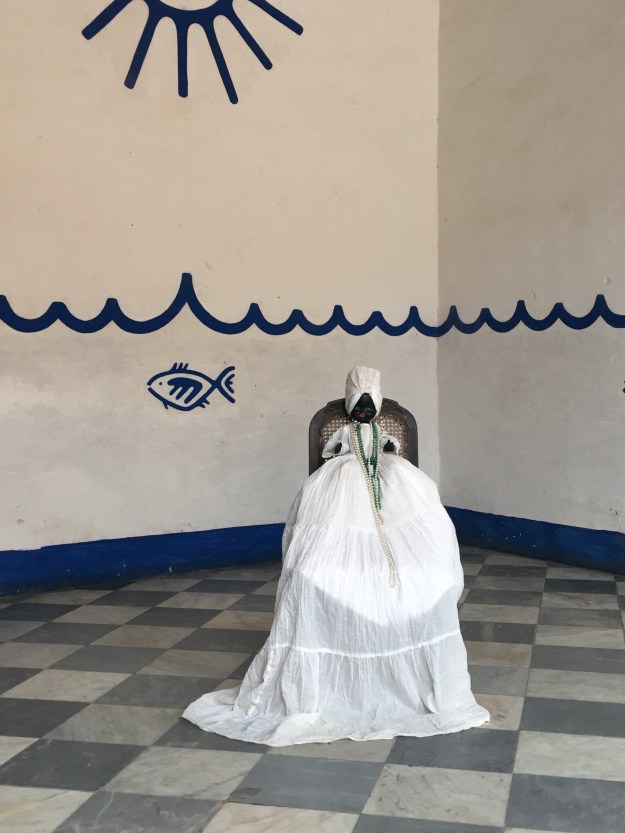
santeria temple

Trinidad, Cuba.

The first time I’d ever heard of Santeria and seen the Casa Templo de Santeria: Yemaya was on the Departures TV series when Canadian travelers, Scott Wilson and Justin  Lukach, walked into what appeared to be a regular storefront business on the cobbled streets of Trinidad.

What they found was  a black “doll” dressed in all white sitting on a chair in the middle of an empty room. She represents the sea goddess, Yemaya.

It’s startling not just because of what it is, but the room has an energy and calmness at the same time.  A very palatable feeling.

The high ceiling, white walls and blue fish and water paintings created a calm and cooler atmosphere contrasting heavily with the heat, humidity and ruggedly cobblestone streets of this UNESCO cited Spanish Colonial city located in the southern, center part of Cuba.

Our group had an appointment with the Temple Priest to learn about this religion that mixes traditions and beliefs brought by West African slaves and over years, mixed with Spanish Colonial Catholicism.

More than 70% of Cubans practice this religion.  Many come to the Priest for advice about work, love, decisions to be made… the advice is typically a mix of prayer and rituals centered around plants, fruits, vegetables and animals.

The Temple is closed on Sunday because the Priests attend mass in the Catholic Church.

This is when I wish I had started my Spanish lessons earlier so that I could return and converse with the Priest.  Through our translator I learned the Priests only wear white and the people I had seen in the streets in all white were either devotees of the religion or studying to become Priests.  Unfortunately, my infant-level Spanish prevented me from further engagement.

Dady, our lead guide had given us all street maps of Trinidad because “the streets all have two names and are confusing because they follow no pattern.”

Boy, was she right.

You learn early that the center of this small community is at the higher elevation and our casa was “down the slope.”  Streets and cobbled and challenging to walk. My husband and I were lost on our afternoon walk and about to head in the completely wrong direction when our son spotted us and put us on the right course.

Hot. Humid. A much poorer community than Cienfuegos the day before.

The peak tourist season had ended which I liked, but it made for empty streets and empty bars.

Our casa was “under construction” and more “rustic” than others. The family, however, was as warm and kind as we had learned to expect.  We had lunch there and were served our first treat of Cuban helado. My husband had both chocolate and vanilla.

He and our son met up with others in the group that evening to find a hotel to watch the NBA playoffs.

I stayed in the room to write and read my book on Che I’d found in the town earlier that day.


Cuba: Day Five (What about Camilo?)

Fidel

Che

Raoul

Camilo

…wait, Who?

Camilo Cienfuegos.

Oh, the image etched in steel alongside a massive building at the Plaza de la Revolution. We thought it looked like Juan Valdez, the coffee guy.

Camilo. Son of a tailor, born in Habana.

Too poor to continue college so he goes to America to find work. His visa expires and he’s sent back to Cuba.

His life changes when Batista’s troops shoot him and others who were honoring the memory of a socialist hero.

He was with Fidel when the Granma landed in Cuba, 2 decembro, 1956 to start the revolution.

A commandant like Che.

The “Hero of Yaquajay.”

He and Che lead the rebels in the final battle against Batista’s reign. Not a shot was fired as the two Comandante’s forces united and surrounded the troops of the President that the not even the US wanted when he fled Cuba the next day.

Commandante Camilo served as head of Armed Forces the first year of Castro’s Government.

Then, one night, his plane mysteriously disappeared, never to be found. He was 27 years old.

Camilo was once asked by Fidel during a speech, “How I’m doing?”

Camilo answered, “Vas bien, Fidel.”

The crowd took up the chant, “Vas bien, Fidel” and the quote is inscribed on the steel outline of his image in the Plaza. “Vas bien, Fidel” An image that was only placed there fifty years after his death. Che’s image had been immortalized there almost immediately after his death.

Even Cubans believe there was mystery behind Camilo’s death. The commandante did not support violence and death against enemies of the state. He was a socialist, perhaps a communist, but was quoted saying he would not treat prisoners the way Batista treated his enemies.

More egregious, however, was he was divorcing his wife to marry a wealthy woman and had always had a “joie de vive” that did not match the seriousness of a revolucion.

Some believe Fidel consolidated his power by sending Che to other countries to promote revolucion and eliminating Camilo undercover of the night.Who really knows? Raoul?

Che died a martyr, every revolution needs one.

Camilo has slowly been recognized on currency, schools, cities, museums…

What will they do when Fidel’s time has come?


Cuba: Day Five

The bus trip from Vinales, southwest of Habana, to Cienfuegos, near the center of the island on the southern shore, was going to take at least six hours of drive time.  Fortunately, we had several stops and the day was of conversation about Cuban history (since Castro’s Revolution) and culture.

The highway was desolate.  Miles pass without seeing any other motorized vehicle.

In the morning we watched a documentary on the bus about Fidel that was made by Americans. It featured many American notables such as former US Attorney General, Ramsey Clark, giving what seemed to be a balanced view of what the Revolucion was about.  In a way, Fidel’s Revolucion felt like an early version of the “anti 1%” activity that occurred briefly in the States in 2014/15 and then was squelched. (Yes, Cubans call their President Fidel, not President Castro)

No question that former Cuban President Batista was a bad boy. It was said during his reign that the U.S. ambassador to Cuba had more power than Batista. Worse, however, was the mafia control of gambling, wealth and industry and the blatant disregard for the average Cuban.

My take away from the documentary was that the United States and Cuban governments allowed dogma and the threat of communism to blind them from clear decision-making in establishing diplomatic relations. Fidel spent much of his time in the United States after the revolution trying to raise money for his island country that, for the first time in its history, was actually being governed by Cubans instead of monarchs from other, primarily European, countries.

After stopping for lunch in a unusual property which seemed to also be a massive petting zoo with buffalo, peacocks and other assorted animals scattered throughout the property, we arrived at the Korimakao Cultural Center.

The Korimakao Cultural Center  in Cinega de Zapata was established by Fidel as a Center where artists could develop their talents. These are young students who are not good enough for the university or for immediate employment in the cabarets or dance and performing troops, so the center is where they can hone their skills.

It is a modest campus of one-story white stucco buildings. There was no air conditioning in any of the buildings we visited and the dormitory restrooms were quite rustic and odorous.

The studios were rooms with open windows and plywood floors that were elevated on two by six beams to provide some measure of flexibility when jumping, especially for the dancers. The first performance presented to our small group was of two male dancers in a lovers quarrel complete with angst, anger and ultimate forgiveness and love.

The two young male dancers were quite earnest in their originally choreographed performance. Though homosexuality has been legal in Cuba since the 1970s, there is still much discrimination and bias against the LBGT Community. It seemed these Male dancers in their early 20s were trying to show how progressive their country was with their slightly homo-erotic performance.

We then watched a couple more performances from the full dance troupe and then listened to an acappella choir.

While there was definitely talent among these young students, it very much felt like a typical high school performance one would see in the United States. Their professional fate was probably no different than the thousands of young artists who pursue Broadway or Hollywood or other artistic venues. Some will make it, most will not.

More driving until we reached Playa Giron, better known as the Bay of Pigs. We stopped along the highway at a location designed just for people like us to swim in the sea or jump into a cenote.

The cenote was located deeper into the jungle down a winding path past the restrooms where we could change into our swimsuits. The cenote looked like a fetid,  mosquito-infested black pool. We all opted for the sea instead.

There was no beach. Instead there was an abrupt drop into deep waters.

“No wonder we lost in the bay of pigs invasion,” said my husband looking at the deepwater.

“Yes, many Cubans have wondered why the Americans selected the southern part of the island to attempt an invasion by sea here. It’s just too deep and there is no easy way onto the land,” said our guide. “Our northern shores are beautiful sandy beaches that can easily be approached by sea.”

Hmmm…

The road between Playa Giron and Cienfuegos contained more billboards with Revolutionary images and slogans than we had seen in any other part of Cuba. Even former Venezuelan dictator, Hugo Chavez, has a notable presence exclaiming the virtues of revolution.(Hmmm, again, given the ruined economic state of Venezuela today)

Cienfuegos is known as the “Pearl of the south.”

It is the largest city we have been near since we left Habana. I immediately noticed how many people seemed to be in their teens and 20s. This is a much younger and more cosmopolitan community than anywhere we have been so far on the island.

Our Casa Particulare was the most luxurious so far. The property was pristine in it’s mosaic tile floors and decor. The second floor balcony was designed for guests to lounge and enjoy the sunset. Our rooms were decorated in bright colored silk sheets and curtains.  Our towels were shaped into swans sitting on top of our beds.

With umbrella in hand, I asked our proprietress, “Lluvia?”. She shook her head no and so I took the umbrella back to my room before boarding the bus to go across town for dinner.

A monsoon struck the town just as we walked into the restaurant. The rain was so heavy that the drainage system began to back up flooding the restaurant. We continued to eat out od respect for the owners and staff who were working so hard to mop and sweep the rising tide out the kitchen door. We simply propped our feet upon the rails of our chairs to not get wet.

It made for fun conversation and great camaraderie with the restaurant staff.


Cuba: Day Four


Cigars stink. But not in Cuba.

I don’t know much about cigars, but I’ve puffed one or two and have been around their foul odor.

Cuban cigars are different.

After spending a morning walking the tobacco fields, meeting the farmer, holding leaves that were curing in the thatched roofed storage house, then watching the farmer’s grown son roll each of us our own cigar…

… I can say these cigars smell and taste sweet and mild.

Most of our group sat in the small hut with Clara and her son puffing away and it was not offensive as cigar rooms elsewhere. No stale, foul odor.

Clara was puffing away on her own cigar when we arrived. I told her, “El nombre de mi abuela es Clara.”

She grinned, nodded and took me under her tutelage showing me how to hold the cigar and puff “just so.”

The family spends nine months harvesting their fields and receive the equivalent of 1,000 CUCs for their labor. “That’s the same cost as 1,000 beers,” says this morning’s guide.

We all stand still looking at our cigars and each other. Work for nine months for the price of 1,000 beers.

Most of us decided to buy as many cigars as allowable from Clara and her family.

The morning walk around the tobacco farm in the heat and humidity was tiring so we  adjourned to our private casas after lunch for siestas during the afternoon rain.

Dinner was on top of another hill with a vista view of the mountains and sunset.  Our tables and chairs sat on a  platform balcony leaning over the cliff.  The kitchen of this small, family-owned paladares was “out back” with the cats, chickens, turkeys, pigs and other farm animals.

The open fire grill was so hot that none  of us could stand within five feet of it.  Our chef just shrugged and prepared another delicious meal (of the same, in-season and only food available meal)

Our group was very compatible and our conversations covered politics, dating, parenting, travel…Dady, our lead guide was educated and well-informed and engaged in sharing her thoughts and perspectives about her country and the world.

Having these dinners talks while on a balcony suspended over the cliff, looking across the valley toward the sun setting behind the mountains made the evening paradise.

For the second night, I thought, “I really don’t want to leave this part of Cuba.”


Cuba: Day Two

Yesterday I had to pay for my second cup of coffee. So today, Shoilen, the young woman who serves us at the Casa, and I figured out I can just drink the one cup allowed each to my husband and son as part of their “free breakfast with room.”

Shoilen  is either in her late teens or early 20s and is a “maesta du salsa.”

“Ah. En el lugar al lado?” I motioned to the place next door where music blared and dancing occurred every afternoon and evening.

“No,” she motioned the other direction. “Dos bloques.”

She and I grinned like co-conspirators that we were when she poured my third cup of coffee. I slipped her 3 CUC’s as a tip. (The average Cuban salary is the equivalent of 40 CUCs per month)


Time to walk.

And walk.

And walk.

The group started at the Museo de la Revolucion y Memorial Granma. It is the former palace, and is elegant with marble staircases, a hall of mirrors work replicating the one in Versailles, ornate bas relief work and interiors design by Tiffany.

Rooms are dedicated to different aspects of the revolucion and contain Che’s beret, canteen and other items (how did they know they were his?). Several bloodstained uniforms and clothes from the martyrs of the Revolucion are displayed in cases.

The guide was proud to point out the more than 300 bullet holes in the Courtyard “where the last battle of the revolucion was fought.” (hmmm? yes to the bullet holes, but the last battle?)

More blood again as she pointed out the stains scattered along walls. We later concluded that it was not exactly correct as some of the stains appeared on walls that have clearly been repainted since 1959.

She tried to walk us quickly past the “Hall of Cretins,” but we were a renegade group and had to take photos of the 10 foot high cartoon characters poking fun at Batista, Ronald Reagan, George H.W. Bush and W.

Batista is a general’s uniform: “Thank you cretin for helped us to make the revolucion”

Reagan is in a cowboy outfit: “Thank you cretin for helped us to strengthen the revolucion”

Bush is in Caesar’s robes: “Thank you cretin for helped us to consolidate the revolucion”

W is in a Nazi helmet and holding a book upside down: “Thank you cretin for helped us to make Socialism irrevocable”

Our guide was afraid we were offended. We all thought it was funny.

It made me realize, again, how much Cuba thinks of itself in relation to the United States, even if negatively. (I don’t think most Americans even think of Cuba)

After that we walked for hours on the streets that were not wide enough for two cars much less a bus.

Walk

Water

Find shade

Stop. Listen. More history.

Please be time for lunch.

We melted into our chairs at the Art Bar surrounded by the owner’s photography. It was the first modern place we had seen in Cuba.

Yay, afterwords we were on our air-conditioned bus to visit Fusterlandia, a Tim Burton psychedelic film come alive on the streets of the Jaimanitas neighborhood.

For more than 20 years, artist José Fuster, has covered every house, roof, wall, sign and curb with brightly colored tiles into mosaics of Che, animals, people, street scenes… whatever.

His personal home feels like a Willy Wonka factory tour tile designs. (Ok, too many film references)

Supposedly all of this has helped his neighborhood become middle class as the residents sell lemonade and painted tile.

I was overwhelmed and went back to the bus.

Next up, La Floridita, for daiquiris supposedly invented there by Hemingway.

Crowded

Fun

Happy people

Live music

Hundreds and hundreds of daiquiris being served in the hour or so that we were there.

Hundreds.

The obligatory photograph with the bronze statue of Hemingway in the corner of his favorite stool.

Frozen drinks after a long hot day of walking was refreshing.

Dinner on our own that night was at Sloppy Joe’s Bar where the specialty is, yes, you guessed it sloppy Joe burgers. My husband found it and I’ve leaned over the years to let him find him “American-type” place for a meal of two.

Sloppy Joe’s is a definite throwback to the Batista era when famous Hollywood celebrities came to the island to enjoy playtime. From the photos on the walls it appears many of them visited Sloppy Joe’s as well.

Early to bed.

Tomorrow we leave Habana and discover a Cuba I never imagined.


.


Cuba: Day One

I was a little surprised when both my husband and son said that their “must see” in Cuba was Hemingway’s house.

The folks at Intrepid Travel told me that all we had to do was ask our proprietress  at our casa to call a cab for us.

Breakfast was on the café chairs and table located in the interior courtyard.

Fresh mango slices, pineapple and banana.

“Huevos con queso o bakon?”

“Um?”

Glance at one another

“Ah”

“Bacon por favor.”

Fresh squeeze juice (mango?)

“Cafe con leche por favor.”

“Agua”

“Agua”

Time to ask the proprietress for a taxi.

Hemingway’s home located in the suburbs of Havana is known as “Finca la Vigia” in American guidebooks. Of course the one guidebook we brought has no mention of Hemingway at all. (Really?)

Our proprietors was very friendly and kind, but she spoke almost no English and our infant level Spanish was mostly ineffective.

“Taxi à la casa du Hemingway?”

(was that French or Spanish or neither)

She smiles. I smile.

We wait.

Try again.

“Es posible…”

Nope.

My son laughs.

“Wrong language, mom.”

“I don’t see you trying.”

With my thumb and pinky finger, I pretend to hold a phone to my ear.

“Taxi à la casa du Hemingway?”

Then I pointed at her and pointed at the phone.

“Ah, si.”

She was on the phone for 15 minutes.

30 minutes later a Soviet era Lada sputters to the front of our casa. I am pretty sure I saw wire holding parts of it together.The small, box-shaped car was a reminder of how the former Soviet Union propped up Cuba’s economy for years… and then pulled out abruptly when Union fell apart.

Cubans call the post-Soviet era the “Special Period.”  The economy bottomed out and most Cubans lost twenty pounds the first year due to food shortages.

Our driver is bald, short, very muscular and wearing a slightly dirty T-shirt revealing tattoos.

“A la museo du Hemingway , wait, y regress. 25 CUC? OK?”

“Si.”

After a considerable amount of yanking on each door, my husband and I settle inside the back seat while our son rides shotgun. The car has no shocks and the seats have no springs and so we bounce our way through the capital of Cuba.

Hermes, our driver, motions us to roll down our windows and we pass through the streets of Habana Viejo, through centro Habana, passing dogs, people, horses, motorcycles and large factories now shuttered closed.

People waiting everywhere. For a ride to somewhere I guess.

Habana’s former elegance is now mostly hidden behind crumbling buildings and faded facades.

Somehow the afternoon rain showers aren’t enough to freshen up public spaces. There are no flowers and no grass in any park or public median.

People seem to linger just to linger.

The high heat and full humidity induces a slower pace. People don’t seem to be in a rush anywhere at anytime.

Hermes stops to ask a parked motorcyclist for directions. Almost there.

We turn off the crowded road and drive up a hill where there are several white Hacienda style buildings, an outdoor café which is just white plastic tables and chairs scattered around a hut and a small stall with tourist items.

Hermes walks us to a woman sitting under a tree where are we pay five CUCs each and walk the path to the writer’s Cuban home.

The house and grounds retain enough beauty to make you wish you’d been there when el Papa was alive.

Well, maybe not since el Papa was a drunk and apparently not really a nice person.  We can pretend though, today, on our visit, that it was different.

Guidebooks say do not go if it’s raining because the house is shuttered closed.  You aren’t allowed inside, but every door and window is open and so we walk around like night stalkers peering in and snapping photos on our phones.

Mosiac tiled floors.

High ceilings

Fans

Books in every room

Trophy animal heads mounted

His military uniform, pressed and hanging in the closet

Only one bedroom though. Guests slept in a house next-door

Patios shaded in flowering trellis’

And the tower.

A watch tower separate from, but next to the main house.

One room on top.

His writing room.

A table, chair, and lounge chair.

Book case.

Telescope with a panoramic view of Habana and the sea.

THE typewriter.

(Though I read where he really didn’t write on a typewriter?)

I didn’t want to leave.

The attendant in the room took my phone and snapped photos I couldn’t from where I stood outside. (our little secret as she quickly handed the phone back when others approached)

Stone paths lead you to the swimming pool, former tennis courts, former arena for cockfighting, past his private softball field, past the cemetery for his four dogs and down to the covered structure where his small yacht, the Pilar, is on display.

The property is so complete with entertainment and comfort that it is a wonder he ever left.

I did not want to leave myself.

But it was time to go.


Walking Flatlands To Prep For Mountains

I’m a very healthy and athletic person, but have a “desk job” with a long commute by car so there’s only so much I can do each day to walk.  I walk at lunch and now am adding an evening walk of one to two hours.  All of this is on flatland.  Actually, flat concrete sidewalks.  Not anything near what I’ll experience hiking 6-8 hours a day up and down 4,000+ km.

I bought hiking shoes this week with proper soft wool socks.  They help my feet and legs feel less stiff and tired. The thirty minutes of yoga after each walk is when I feel the real relief from mild aches.  How will I practice the intensity of what I’ll experience four days and three nights on the trail between Cusco and Machu Picchu though?

My husband suggested we go to Colorado this summer and spend several days hiking up and down various mountains. Good idea, but I wonder if that’ll be enough prep?  I think I just have to assume yes and prep my mind for success as much as my body.