Tag Archives: peace

Cuba: Days Eight & Nine

we 3 in front of che

“Ever Onward to Victory”

Our final two days were back in Habana.

Impressions:

Yes, Cuba is poor in materials and even natural resources.

Tourism seems to be its most stable and successful business.

Outside Habana, the country is a beautiful island with hills, mountains, rivers, waterfalls, biospheres, chickens roaming everywhere and roosters waking you at 4:45 AM.

People outside walking, walking, walking, hitching a ride when they can, rarely a private car in sight.

Food extremely limited in variety but served with pride in generous portions.

Music.

Dance.

Heat. Humidity.

Kindness. Smiles.

Feeling, not like a tourist. No begging. No hassles.

Cubans love their country and see its flaws. They want a better standard of living but don’t want to be “too commercial like America.”

Cubans we met love Americans and think our two governments are “silly and we need to be friends.”

Cubans love Fidel and know he’s “holding on too much to the revolution.”

Cubans love Raoul and “believe will take us forward.”

They are proud of their schools and medicine.

Stay in a Casa Particulares with Cuban families. The hospitality is enriching to the soul.

Eat in a palador, not restaurants for the same reason.

Swim in the sea.

Hike in the hills.

Walk the tobacco farms.

Learn the revolucion, Bay of Pigs, and the embargo from their perspective.

Buy books written from their perspective.

Leave behind as much as you can: lotions, sunscreens, toilet paper, mosquito repellant, clothes, tips… the staff at the casas appreciate it greatly.

Listen as much as you can.

Ask questions.

Learn as much Spanish as you can and speak it.

Leave behind your kindness and compassion.

Take with you a better understanding that people are people.

We really want the same things.


Cuba: Day Seven

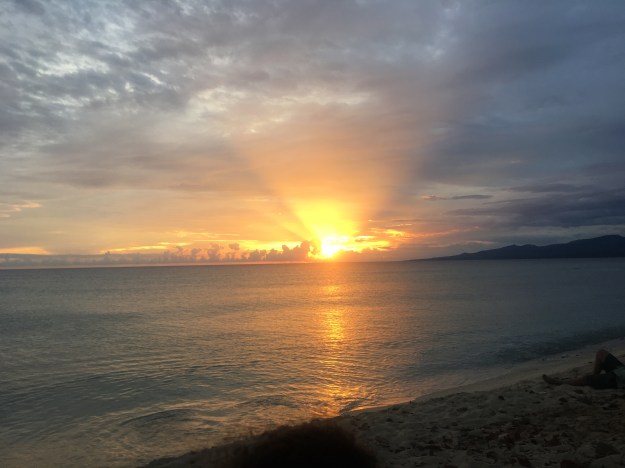
cuban beach sunset

Cuba may be poor and lack so many resources, but it is a beautiful island.

We spend an hour in the morning walking through the national park ” El Cubano” in the mountains of Escambay, just a thirty minute drive outside Trinidad.  The area is lush with a diversity of plants, birds and animals.  We had a guide who first attempted to narrate us through the biodiversity of the area, but we were rebelling that morning and were focused on reaching the end of the trail where a waterfall awaited.

Of course it was hot. Of course it was humid. It’s a tropical island.

The walk was up and down easy hills and we were all drenched in sweat when we reached our destination. The waterfall cascaded into a clear pool of cold water. Most of our group stripped to our swim suits and jumped in.

Our pace one tour was slowing down.  We only had another day together and by now, clusters of friends had formed: the under 40 New Yorkers; the two families bonded withe  50-something couple from New York; the 60-something couple from Oregon protecting the married mom traveling alone;the two single men from California each kept to themselves, but not awkwardly so.  The group worked well together during our nearly two weeks together.

We asked question of our guide and office other about Cuban politics and life; American politics; each others jobs… not surprisingly a high percentage of the group worked in non-profits or higher education.  We were balanced by our New Yorkers working in advertising, law and “investments.”

Dinner was at Playa Ancon.

Our bus stopped at what seemed to be someone’s house.  It was our caterer and our musicians for our evening on the beach.  The beach was almost vacant and what few people  were there left soon after our arrival because a storm was blowing our way. We thought for sure were we about to be hit with a tropical storm,  but, Dady, our lead guide said, “Let’s see…”

Everyone left the beach except us.

We were rewarded for our faith.

The few raindrops didn’t even dampen our clothes.

The sunset performed for us along with our musicians. Fresh fish, veggies and rum…an abundance of rum along with a few Cuban cigars.

Celebration in the joy of Cuba’s beauty.


Cuba: Day Five (What about Camilo?)

Fidel

Che

Raoul

Camilo

…wait, Who?

Camilo Cienfuegos.

Oh, the image etched in steel alongside a massive building at the Plaza de la Revolution. We thought it looked like Juan Valdez, the coffee guy.

Camilo. Son of a tailor, born in Habana.

Too poor to continue college so he goes to America to find work. His visa expires and he’s sent back to Cuba.

His life changes when Batista’s troops shoot him and others who were honoring the memory of a socialist hero.

He was with Fidel when the Granma landed in Cuba, 2 decembro, 1956 to start the revolution.

A commandant like Che.

The “Hero of Yaquajay.”

He and Che lead the rebels in the final battle against Batista’s reign. Not a shot was fired as the two Comandante’s forces united and surrounded the troops of the President that the not even the US wanted when he fled Cuba the next day.

Commandante Camilo served as head of Armed Forces the first year of Castro’s Government.

Then, one night, his plane mysteriously disappeared, never to be found. He was 27 years old.

Camilo was once asked by Fidel during a speech, “How I’m doing?”

Camilo answered, “Vas bien, Fidel.”

The crowd took up the chant, “Vas bien, Fidel” and the quote is inscribed on the steel outline of his image in the Plaza. “Vas bien, Fidel” An image that was only placed there fifty years after his death. Che’s image had been immortalized there almost immediately after his death.

Even Cubans believe there was mystery behind Camilo’s death. The commandante did not support violence and death against enemies of the state. He was a socialist, perhaps a communist, but was quoted saying he would not treat prisoners the way Batista treated his enemies.

More egregious, however, was he was divorcing his wife to marry a wealthy woman and had always had a “joie de vive” that did not match the seriousness of a revolucion.

Some believe Fidel consolidated his power by sending Che to other countries to promote revolucion and eliminating Camilo undercover of the night.Who really knows? Raoul?

Che died a martyr, every revolution needs one.

Camilo has slowly been recognized on currency, schools, cities, museums…

What will they do when Fidel’s time has come?


Cuba: Day Four


Cigars stink. But not in Cuba.

I don’t know much about cigars, but I’ve puffed one or two and have been around their foul odor.

Cuban cigars are different.

After spending a morning walking the tobacco fields, meeting the farmer, holding leaves that were curing in the thatched roofed storage house, then watching the farmer’s grown son roll each of us our own cigar…

… I can say these cigars smell and taste sweet and mild.

Most of our group sat in the small hut with Clara and her son puffing away and it was not offensive as cigar rooms elsewhere. No stale, foul odor.

Clara was puffing away on her own cigar when we arrived. I told her, “El nombre de mi abuela es Clara.”

She grinned, nodded and took me under her tutelage showing me how to hold the cigar and puff “just so.”

The family spends nine months harvesting their fields and receive the equivalent of 1,000 CUCs for their labor. “That’s the same cost as 1,000 beers,” says this morning’s guide.

We all stand still looking at our cigars and each other. Work for nine months for the price of 1,000 beers.

Most of us decided to buy as many cigars as allowable from Clara and her family.

The morning walk around the tobacco farm in the heat and humidity was tiring so we  adjourned to our private casas after lunch for siestas during the afternoon rain.

Dinner was on top of another hill with a vista view of the mountains and sunset.  Our tables and chairs sat on a  platform balcony leaning over the cliff.  The kitchen of this small, family-owned paladares was “out back” with the cats, chickens, turkeys, pigs and other farm animals.

The open fire grill was so hot that none  of us could stand within five feet of it.  Our chef just shrugged and prepared another delicious meal (of the same, in-season and only food available meal)

Our group was very compatible and our conversations covered politics, dating, parenting, travel…Dady, our lead guide was educated and well-informed and engaged in sharing her thoughts and perspectives about her country and the world.

Having these dinners talks while on a balcony suspended over the cliff, looking across the valley toward the sun setting behind the mountains made the evening paradise.

For the second night, I thought, “I really don’t want to leave this part of Cuba.”


Ok Then, Just Write

I remember being scared to say out loud, “I want to be a writer.”

That’s not entirely true. I declared to my mother when I was 11 that I wanted to be a journalist for National Geographic Magazine. Her immediate response was,”Well then you’ll always be lonely.” I guess back then the thinking was still that restrictive for girls; maybe it still is. That deflating comment came from a very progressive mother, and it stung for decades.

It took me until age 40, yes 40, before I could declare to my husband and two closest, lifelong best friends that “I want to be a writer.” Seventeen years later, I’m still primarily writing in my journal. I tweet for my public professional persona. I submitted one short story once to one publication. They printed it, paid me, and the editor wrote me a note thanking me for sharing such a touching story.

I blog, sometimes.

More and more though I hear the deep voice of myself wonder”Why?” Why do I fight what my soul wants?

At this stage in life it doesn’t even matter if people like my writing. It’s more about my need to do what I was put here to do.

Write. Just write.