The fog of fantasy
has burned off.
Reality looks
stark.
I want to dream again.
The fog of fantasy
has burned off.
Reality looks
stark.
I want to dream again.
I have had to find a new cafe for my morning writing sessions as the old one permanently closed.
The new cafe, though just across the road from the old one, has two or three regulars who appear to be without permanent homes. Their clothes are frayed and their possessions are plastic bags. One is a woman who does have a bicycle and a black daypack (like me). She sits in the corner charging an old cell phone. I’ve never seen her with food or even a cup of coffee.
I’m new to this place and wonder the management’s protocol about paying for other guests’ food.
I want to just say to her one morning, “Can I buy you breakfast?”
How hard would that be? I’ve done it before in other places. Why hesitate here?
What do I fear? Engagement?
Maybe tomorrow. Maybe tomorrow.

Isn’t “right now” our path?

prancing and dancing
strutting past the witch’s house
I welcome them all
It’s hot outside
Summer should be over now
Feeling stuck in time

Steve Connors was a good man. A regular guy meaning he played football in high school, made B’s and C’s at the state University, graduated, rabble-roused a little bit in his youth, got a job, married a good woman he had known a long time, had two kids, only cussed with his buddies or when alone, was a good son, was a good son-in-law, and paid his taxes.
He knew something was really wrong when he woke up. Everything was white. White sheets, white walls, white…
“What is that?” He wondered.
“White mist? Am I on a friggin’ cloud?”
Steve bolted up. He was wearing white cotton pajamas. I never wear white cotton pajamas. He looked around. There was no furniture, no windows, no doors.
“Am I in an insane asylum?”
He was feeling sweaty, agitated, confused, and a bit scared though he was good at keeping that last emotion in check.
He looked at the floor. White mist.
“I’m in a cloud.” He decided not to step down.
“I’m dead.”
He pinched his skin.
“Nope.”
He yelled, “Hello?!”
Silence. Absolute silence. Then…
“Hello, Steve.”
“Holy shit!” Steve jerked. “Where’d you come from?”
“Just right there,” She said pointing nowhere. She looked older than Steve but younger than his mother.
“Where the fuck am I… sorry about my bad language.”
“You’re in between.”
“In between what?”
“Life and death.”
Steve felt numb. He didn’t move at all for several minutes.
“It’s confusing I know. But you and I have to talk about some important things right now, Steve.”
“Is this one of those near-death experiences I hear about? People going to the light and then come back into the body?”
She smiled.
“Something like that.”
Steve shifted around in the bed.
“This is fucked up shit. Am I drunk?”
“No.”
“Then where am I? What is this place? Are we on a cloud?”
She smiled again.
“It’s like a cloud. You are between living on Earth and leaving, dying, from Earth. You and I need to talk about some very important things. She paused. “ And then you have to decide what you’re going to do.”
“Decide what?”
“Decide what you’re willing to do if you return to Earth.”
“If!”
“Yes, Steve. You made a deal with me before you were born on Earth and you’ve not lived up to your part. Yet.”
“Lady, I’ve never seen you before.”
“You have. You just don’t remember.”
“Am I in a hospital dying from cancer or a car accident?”
“No. You were one of nineteen people shot at your daughter’s school picnic. A gunman with an AR-15 assault weapon walked onto the grounds and fired multiple rounds into the children, also hitting some parents.
“Fifteen children are dead. Four of you are being rushed to the hospital. Two will die on the way. Two of you are having conversations with your Guides right now.”
Steve had his hands on either side of his head trying to hold in his racing thoughts.
“Fifteen children are dead?”
“Yes.”
“Two more people will die?”
“They just have actually.”
“Who?”
“I’m sorry to tell you that your daughter, Annabella, was one of them.”
Steve screamed and started to get out bed, but looked down at the mist then fell back on the bed.
“She was one of the ones who just died?”
“Yes, Steve. She didn’t suffer though.”
Steve was sobbing. Shoulders slumped. Defeated.
“My precious baby girl.”
Steve rolled onto his stomach and buried his head in the pillows, crying.
He woke with a start.
“Shit. Am I in the same place?”
He flipped around. She was still there.
“How long was I asleep?”
“A while.”
“What is happening to me on Earth?”
“You’re just now entering the emergency room.”
“What? It’s been forever.”
“Time and space are different here, Steve.”
Steve closed his eyes. Rubbed them. Shook his head.
“OK. What is it I’m supposed to learn? What deal did we make? And why did Annie have to die!” He was screaming again.
“Annie died because she fulfilled her purpose on Earth.”
“She was only eight. What purpose could have been done by then?”
“The deal she made before being born was that she was willing to die the way she did.”
“She knew she would be killed?”
“She knew while she was here, but she didn’t know it on Earth. Steve, because she fulfilled her agreement she did not suffer at all when she died.”
“Why would she agree to die like that?”
“So you would have the chance to course correct your life.”
Steve could only look at her.
She stood silently. Her face was gentle.
“Okay okay. So what have I done wrong?”
“It isn’t a case of doing something wrong per se. It’s a case of do you want to fulfill your real purpose on Earth instead of just living a good, decent life.”
“A good life isn’t good enough I guess. I don’t know what you mean by me living my real purpose. I’m a decent man.”
“Yes you are. She waited. “And you agreed that you would be more.”
“Can you just tell me what I need to do? I’m getting really tired of this conversation.”
She smiled again. “Why do you think it was a gunman with a powerful, military-type assault rifle that killed your daughter, and now, sixteen other people, and has you and another person pending?”
“I don’t know. I don’t know. I’ve always been responsible with guns. Granddaddy taught me to respect guns. I’ve always had to clean my rifle before we went hunting. We always eat what we kill. I have never been sport hunting. I don’t believe there is such a thing as ‘sport’ in hunting.”
“Exactly.”
“Exactly. Exactly what?”
“You have always been very respectful of guns. You have always been very careful. Why then do you let others talk and behave irresponsibly about guns?”
“I can’t stop people from buying what they are legally allowed to buy. Shit. Is this about gun control?”
She smiled.
“You’re fucking kidding me!”
“Steve, I think it’s a little bit more since you’re here. You made a deal with me before you were born on earth that you were going to be the voice of reason about guns. You agreed You would be willing to stand up to your friends and the NRA so that things did not get out of hand about guns the way they have.
“You’ve done nothing about it for years.
Steve, people like you. People respect you. People follow you. You have never been out of control with guns. You have never been unreasonable with the type of guns and ammunition you purchase.
“The deal was that you would use your credibility as “one of the guys”, a hunter, to be a leader in your country to bring sanity to the type of weapons and ammunition that are available, and more importantly, how people gain access to guns.
“Annabel agreed to be your daughter knowing she would be gunned down if you didn’t step up to your higher purpose.
“You have a choice now. Her death can mean nothing, or you can step up and live your higher purpose on Earth.
“You mean I live?”
She smiled.
Steve closed his eyes and cried again.
When Steve Connors opened his eyes, he saw his wife sitting beside him. Her eyes were red and swollen from crying. She sobbed when she saw that Steve was now waking up after his surgery.
“It’s a miracle, thank you God, it’s a miracle,” was all she could say when she collapsed into Steve’s arms.
“Honey, it’s okay. I’m okay.”
“Annie…” his wife started to say.
“Honey, Annie is okay. I know she’s gone from us here, but I’ve been to heaven. I know Annie didn’t die with pain.
“And she won’t die in vain either honey.
“Babe, there’s no guns in heaven and we’re going to bring just a little bit of that heaven down here on earth.”
Author’s Note: This story was written years ago, long before the current mass shootings in Uvalde, Texas and Buffalo, New York.

I, too, would shout and scream
kick and bite
and do every dirty trick
I could
If you were trying to hurt me
and had been doing so for a long time.
Floods, tornadoes, extreme heat, pandemic…
have had to become your defense weapons.
And so, my Mother Earth,
I have no complaint with you.
You have no choice.
You have forgiven us too many times before
and we are no longer
worthy of your grace.
Poetry cracks open
the shell
we spend all day
building around
our true Self.
The moon
looks like a gentle watercolor
fading in the sky this morning.
Only the birds and squirrels
seem to be awake
and me.
There’s a falcon
sitting on a neighbor’s mailbox.
A falcon.
In the city.
I stopped and looked.
The falcon stopped and looked too.
Then he flew away.
And I walked on.
There’s a very thin layer on ice
on the creek,
I stop
and just look as the sunlight
glistens it.
As I round the curve in the road
back toward my house
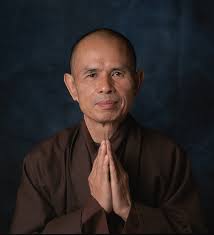
I remember Thich Nhat Hanh
who died earlier today.
I thank him for teaching the world
how to walk
mindfully.
22 enero 2022