Category Archives: spirituality

#SolarEclipse2017 Ten months before

I didn’t know about the 2017 solar eclipse until my friend, Rob, told me about it in the fall of 2016.  It was almost a throw away comment he made during lunch with our spouses, but I pounced on it.

That night I found the path the eclipse will journey across America on August 21 and started my search for cheap hotels . I found none.  In desolate areas, the hotel equivalent of a “Motel Six” were already $3,000 per night.  Repeat that: “$3,000 per night.”  The eclipse was still ten months away and rates were already reflecting the # 1 American value: money. Ugh.

Camping was not an option for me because I have none of the equipment and really don’t know what I’m doing. So, throughout the fall, I’d hunt and peck on the internet now and then, trying to find some place to stay on the path.

Not unlike Rob’s casual mentioning of this event to me, I casually mentioned it to my adventurous friend, Vicki, who immediately said, “We have to do this somehow.”  It was December 2016, eight months to eclipse day, and rates were exceeding $6,000 per day.

So we decided we were going to drive from where she lived— about five hours to the center of one of the “best viewing sites” according to the NASA map. We will just drive there, see the eclipse, and drive back.

This was the plan back in December.

Wondering if this is going to be like Thelma and Louise, minus the bad stuff?

More to come…


Moo Monday

cow-kissing-cow

Here’s something you can easily do today to make the world a better place… skip meat today.

There is a trend called “Meatless Mondays,” but that implies you have to do “without something.”  I’d like to turn that around and make it proactive…just skip eating meat today, and every Monday.  No big deal to you. In fact there are many benefits.

Here are just a few of those benefits from the folks at “Meatless Monday:”

Why Meatless?

Because going meatless once a week may reduce your risk of chronic preventable conditions like cancer, cardiovascular disease, diabetes, and obesity. And going meatless once a week can also help reduce our carbon footprint and save precious resources like fossil fuels and fresh water.

For Your Health:
Reduce Heart Disease and Stroke—Vegetables, fruit, and whole grains have been shown to protect against cardiovascular disease. One study found that each daily serving of fruits or vegetables was associated with a 4% decline in coronary heart disease, and a 5% lower risk of stroke.[1] Another study found that a diet of 2.5 or more servings of whole grain per day was associated with a 21% lower risk of cardiovascular disease (heart disease, stroke, fatal cardiovascular disease).[2]
Limit Cancer Risk—There is convincing evidence that red meat and processed meat consumption increases the risk of colorectal cancer. There is also limited but suggestive evidence that red meat increases the risk of esophagus, lung, pancreas, and endometrium cancer and that processed meat consumption increases the risk of esophagus, lung, stomach, and prostate cancer. In contrast, a diet rich in fruit and vegetables decreases the risk of several types of cancers, including mouth, pharynx, larynx, esophagus, and stomach, evidence suggests.[3]
Fight Diabetes—Research suggests that plant-based diets, particularly those low in processed meat, can reduce your risk of type 2 diabetes.[4] Eating a plant-based diet can decrease total calorie consumption which helps you obtain and maintain a healthy weight, a key component to preventing and treating diabetes.[5]
Curb Obesity—Several large studies in Europe and the United States have demonstrated that people on plant-based, vegetarian diets tend to have a significantly lower body weight and body mass index (BMI). This may be in part because plant-based diets are rich in fiber (which is not found in animal products). Fiber contributes to fullness, resulting in lower calorie intake and less overeating.[6],[7],[8],[9]

Live Longer—Evidence suggests that eating a diet rich in fruits and vegetables, and a limited amount of red meat can increase longevity, whereas red and processed meat consumption is associated with increases in deaths due to cancer and cardiovascular disease.[10]

Improve The Nutritional Quality of Your Diet—Going meatless encourages consumption of plant-based sources of protein, like beans and peas. Consuming beans and peas results in a higher intake of fiber, protein, folate, zinc, iron, and magnesium. Also, diets high in beans and peas are associated with lower intakes of saturated fat and total fat.[11]

For Your Wallet:

Curb Healthcare Spending—Each year in the United States, chronic diseases like heart disease, stroke, cancer, and diabetes cause 7 in 10 deaths, and account for 75% of the $2 trillion spent on medical care.[12] In 2008, the estimated health care costs related to obesity were $147 billion.[13] By reducing our risk for these conditions, we can curtail healthcare spending nationwide.

Cut Weekly Budget—Many people save money by adding meatless meals to their weekly menus. Meatless meals are built around vegetables, beans and grains—instead of meat, which tends to be more expensive.[14] This is partly because producing meat requires extra expenses like feed and transportation. Though it can be challenging to serve healthy meals on a budget, going meatless once a week can help conserve money for more fruits and vegetables.
For the Environment:
Minimize Water Usage—The water needs of livestock are much greater than those of vegetables and grains.

– Approximately 1,850 gallons of water are needed to produce a single pound of beef.
– Approximately 39 gallons of water are needed to produce a pound of vegetables.[15]

Americans consume nearly four times the amount of animal protein than the global average.[16] When compared with current food intake in the US, a vegetarian diet could reduce water consumption by up to 58% per person.[17]
Reduce Greenhouse Gases —Studies show that meat production produces significantly more greenhouse gases than vegetables, including carbon dioxide, Methane and Nitrous Oxide – the three main contributing sources of greenhouse gas. Beef was found to produce a total of 30 kg of greenhouse gas (GHG) per kg of food, while carrots, potatoes and rice produce .42, .45 and 1.3 kg GHG per kg of food, respectively.[18]
Reduce Fuel Dependence—About 25 kilocalories of fossil fuel energy is used to produce 1 kilocalorie of all meat based protein, as compared with 2.2 kilocalories of fossil fuel input per 1 kilocalorie of grain based protein produced.[19] The meat industry uses so much energy to produce grain for livestock that if instead we used the grain to feed people following a vegetarian diet, it would be enough to feed about 840 million people.[20]

Someday

img_0482.jpg

Conditions are never perfect. “Someday” is a disease that will take your dreams to the grave with you. If it’s important to you and you want to do it “eventually,” just do it and correct course along the way.  -Timothy Ferriss

Cuba: Days Eight & Nine

we 3 in front of che

“Ever Onward to Victory”

Our final two days were back in Habana.

Impressions:

Yes, Cuba is poor in materials and even natural resources.

Tourism seems to be its most stable and successful business.

Outside Habana, the country is a beautiful island with hills, mountains, rivers, waterfalls, biospheres, chickens roaming everywhere and roosters waking you at 4:45 AM.

People outside walking, walking, walking, hitching a ride when they can, rarely a private car in sight.

Food extremely limited in variety but served with pride in generous portions.

Music.

Dance.

Heat. Humidity.

Kindness. Smiles.

Feeling, not like a tourist. No begging. No hassles.

Cubans love their country and see its flaws. They want a better standard of living but don’t want to be “too commercial like America.”

Cubans we met love Americans and think our two governments are “silly and we need to be friends.”

Cubans love Fidel and know he’s “holding on too much to the revolution.”

Cubans love Raoul and “believe will take us forward.”

They are proud of their schools and medicine.

Stay in a Casa Particulares with Cuban families. The hospitality is enriching to the soul.

Eat in a palador, not restaurants for the same reason.

Swim in the sea.

Hike in the hills.

Walk the tobacco farms.

Learn the revolucion, Bay of Pigs, and the embargo from their perspective.

Buy books written from their perspective.

Leave behind as much as you can: lotions, sunscreens, toilet paper, mosquito repellant, clothes, tips… the staff at the casas appreciate it greatly.

Listen as much as you can.

Ask questions.

Learn as much Spanish as you can and speak it.

Leave behind your kindness and compassion.

Take with you a better understanding that people are people.

We really want the same things.


Cuba: Day Seven

cuban beach sunset

Cuba may be poor and lack so many resources, but it is a beautiful island.

We spend an hour in the morning walking through the national park ” El Cubano” in the mountains of Escambay, just a thirty minute drive outside Trinidad.  The area is lush with a diversity of plants, birds and animals.  We had a guide who first attempted to narrate us through the biodiversity of the area, but we were rebelling that morning and were focused on reaching the end of the trail where a waterfall awaited.

Of course it was hot. Of course it was humid. It’s a tropical island.

The walk was up and down easy hills and we were all drenched in sweat when we reached our destination. The waterfall cascaded into a clear pool of cold water. Most of our group stripped to our swim suits and jumped in.

Our pace one tour was slowing down.  We only had another day together and by now, clusters of friends had formed: the under 40 New Yorkers; the two families bonded withe  50-something couple from New York; the 60-something couple from Oregon protecting the married mom traveling alone;the two single men from California each kept to themselves, but not awkwardly so.  The group worked well together during our nearly two weeks together.

We asked question of our guide and office other about Cuban politics and life; American politics; each others jobs… not surprisingly a high percentage of the group worked in non-profits or higher education.  We were balanced by our New Yorkers working in advertising, law and “investments.”

Dinner was at Playa Ancon.

Our bus stopped at what seemed to be someone’s house.  It was our caterer and our musicians for our evening on the beach.  The beach was almost vacant and what few people  were there left soon after our arrival because a storm was blowing our way. We thought for sure were we about to be hit with a tropical storm,  but, Dady, our lead guide said, “Let’s see…”

Everyone left the beach except us.

We were rewarded for our faith.

The few raindrops didn’t even dampen our clothes.

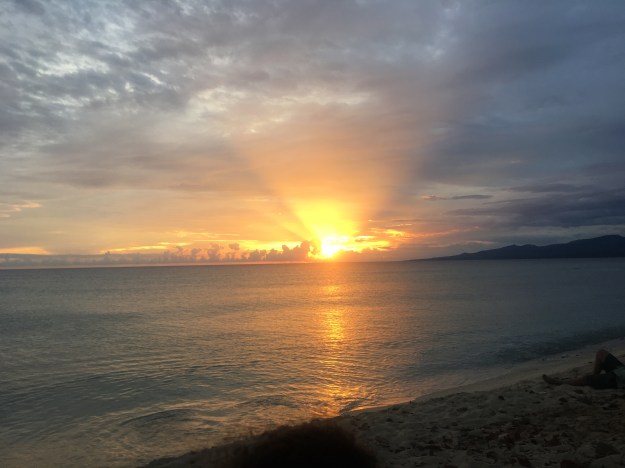
The sunset performed for us along with our musicians. Fresh fish, veggies and rum…an abundance of rum along with a few Cuban cigars.

Celebration in the joy of Cuba’s beauty.


Cuba: Day Six

santeria temple

Trinidad, Cuba.

The first time I’d ever heard of Santeria and seen the Casa Templo de Santeria: Yemaya was on the Departures TV series when Canadian travelers, Scott Wilson and Justin  Lukach, walked into what appeared to be a regular storefront business on the cobbled streets of Trinidad.

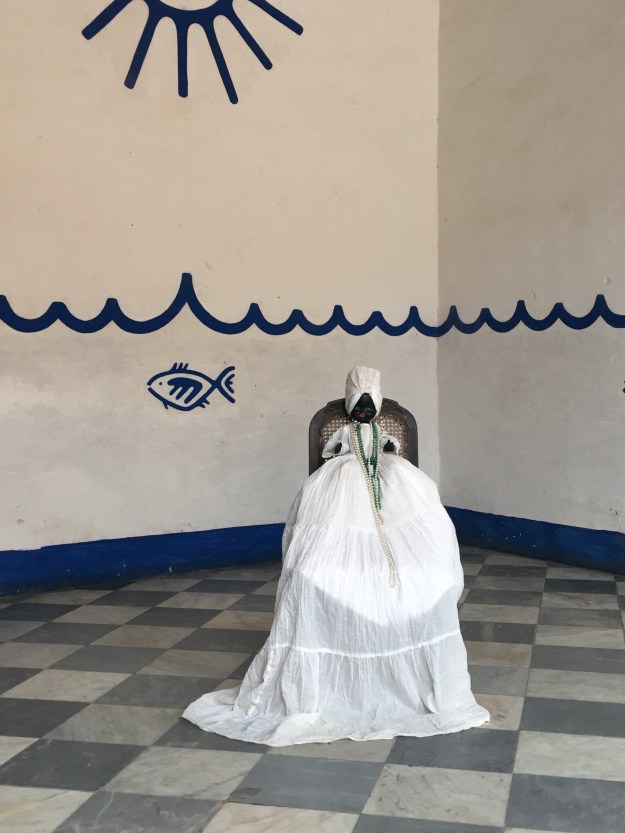
What they found was  a black “doll” dressed in all white sitting on a chair in the middle of an empty room. She represents the sea goddess, Yemaya.

It’s startling not just because of what it is, but the room has an energy and calmness at the same time.  A very palatable feeling.

The high ceiling, white walls and blue fish and water paintings created a calm and cooler atmosphere contrasting heavily with the heat, humidity and ruggedly cobblestone streets of this UNESCO cited Spanish Colonial city located in the southern, center part of Cuba.

Our group had an appointment with the Temple Priest to learn about this religion that mixes traditions and beliefs brought by West African slaves and over years, mixed with Spanish Colonial Catholicism.

More than 70% of Cubans practice this religion.  Many come to the Priest for advice about work, love, decisions to be made… the advice is typically a mix of prayer and rituals centered around plants, fruits, vegetables and animals.

The Temple is closed on Sunday because the Priests attend mass in the Catholic Church.

This is when I wish I had started my Spanish lessons earlier so that I could return and converse with the Priest.  Through our translator I learned the Priests only wear white and the people I had seen in the streets in all white were either devotees of the religion or studying to become Priests.  Unfortunately, my infant-level Spanish prevented me from further engagement.

Dady, our lead guide had given us all street maps of Trinidad because “the streets all have two names and are confusing because they follow no pattern.”

Boy, was she right.

You learn early that the center of this small community is at the higher elevation and our casa was “down the slope.”  Streets and cobbled and challenging to walk. My husband and I were lost on our afternoon walk and about to head in the completely wrong direction when our son spotted us and put us on the right course.

Hot. Humid. A much poorer community than Cienfuegos the day before.

The peak tourist season had ended which I liked, but it made for empty streets and empty bars.

Our casa was “under construction” and more “rustic” than others. The family, however, was as warm and kind as we had learned to expect.  We had lunch there and were served our first treat of Cuban helado. My husband had both chocolate and vanilla.

He and our son met up with others in the group that evening to find a hotel to watch the NBA playoffs.

I stayed in the room to write and read my book on Che I’d found in the town earlier that day.